
Carpenter Ants: A Warning Sign for Moisture Damage in Your Foundation Framing
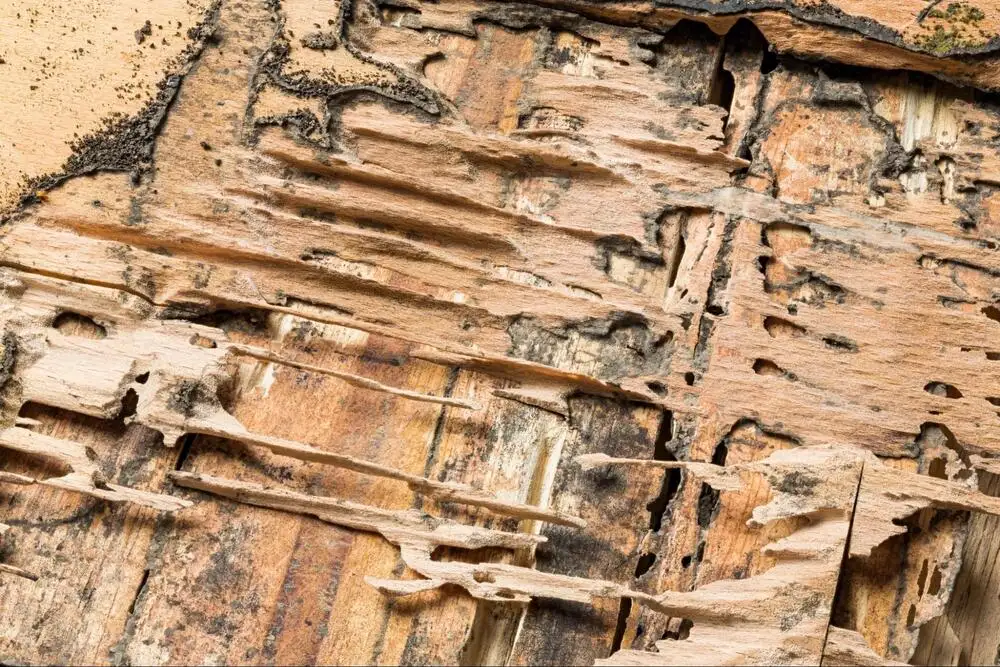
Carpenter ants don't eat wood, but they nest in it. Their presence in a home's structure almost always indicates moisture-damaged framing that is soft enough for them to excavate.
Not sure which fix applies to your situation? Browse our full range of solutions for foundation repair.
[ 01 ] Watch For These Signs
Signs of Carpenter Ant-Related Structural Moisture Damage
Sawdust-like frass near foundation walls or floor joists
Carpenter ants push their excavated material out of their galleries in the form of coarse sawdust mixed with insect parts and soil. Finding this frass near framing members confirms active nesting.
Ants appearing indoors in late spring
Large black ants appearing inside the house, especially near perimeter walls and in the kitchen or bathrooms, during spring swarming season often originate from a crawl space colony rather than outdoor nesting.
Soft or spongy wood when probed
Foundation sill plates or floor joists that feel soft when probed with a screwdriver, or that show visible discoloration and checking, have moisture damage. Carpenter ants and rot are rarely far behind.
Visible crawl space moisture damage
Dark staining, visible mold, and a musty odor when opening the crawl space access door are signs of the chronic moisture conditions that produce both wood rot and carpenter ant infestation simultaneously.
Chronically wet crawl spaces soften sill plates, floor joists, and beam ends, creating ideal nesting conditions for carpenter ants. The ants excavate galleries through the softened wood, further weakening structural members.
Negative drainage around the perimeter of the house directs surface water toward the foundation wall, keeping the sill plate and rim joist areas chronically moist and attractive to carpenter ants.
Without an effective vapor barrier over the crawl space soil, ground moisture evaporates upward and condenses on the cooler wood framing above, maintaining the elevated moisture content that carpenter ants require.
A roof leak or slow plumbing leak that has dampened ceiling or wall framing over time can also create carpenter ant habitat. The ants follow the moisture gradient, sometimes from a roof penetration down through the exterior walls to the crawl space.
[ 04 ] Regional Context
Why Middle Tennessee foundations fail.
Middle Tennessee's expansive Maury and Dickson series clay soils shrink in dry summers and swell after rain, cycling by up to 15% in volume. Davidson, Williamson, and Rutherford County homes built directly on this clay face ongoing movement pressure. Ground Up diagnoses and permanently stabilizes foundations across the region.
Every time I find carpenter ants in a crawl space, I know I'm going to find moisture damage. The ants are honest indicators. Fix the water source, fix the wood, and the ants find somewhere else to be.
[ 05 ] Why Ground Up
The difference is in the diagnosis
Get several quotes and you'll see a wide range of prices. The gap isn't luck. It's whether the contractor finds the actual cause and stands behind the work.
- In-house certified crews: we never subcontract your repair
- Optional independent third-party engineer review on larger jobs
- Honest three-tier triage: we tell you what can wait, in writing
- Family owned from the same Shelbyville Highway address since 2009
[ 06 ] FAQ
Carpenter Ant Infestation questions
Extermination eliminates the ants but does not address the moisture-damaged wood or the water source causing it. Without fixing the crawl space moisture, new ant colonies will reinvade within one or two seasons.
Over several years, active colonies can hollow out significant sections of floor joists, beam ends, and sill plates. In severe cases, this structural excavation contributes meaningfully to floor sag and load-bearing capacity reduction. The damage compounds because the ants also introduce moisture and allow rot to accelerate in the excavated areas.
We address the moisture source first, which usually means improving crawl space drainage, installing or replacing vapor barriers, and improving ventilation or installing encapsulation. Any structurally compromised framing is then sistered or replaced. Pest control is coordinated alongside the structural work.

Free guide
Get the free foundation settlement guide
- A room by room checklist of warning signs
- How Middle Tennessee red clay can move a house
- What happens at a free inspection
Your guide is on its way.
Check your inbox for an email from Ground Up Foundation Repair. If it is not there in a few minutes, check your spam or promotions folder.
More Problem Signs
Other signs to watch for
Bouncing or Springy Floors
A floor that bounces when you walk across it, feels spongy or soft in specific areas, or vibrates noticeably when someone moves in an adjacent room is a floor that lacks adequate structural support below it. In Middle Tennessee, this symptom is most common in pier-and-beam homes, houses with a crawl space beneath the living area, where the supporting wood beam and joist system has been weakened by moisture, age, or original under-construction.
Bowing Basement Walls
A bowing basement wall has visibly deflected inward from the outside soil pressure pressing against it. In Middle Tennessee, the region's expansive red clay absorbs moisture and swells against foundation walls, generating lateral pressure that concrete block, brick, and even poured concrete walls cannot always resist indefinitely. What starts as a hairline crack can progress to a visible curve in the wall face, and once a wall begins moving, the cycle accelerates.
Cracked Block Foundation Walls
Concrete masonry unit (block) foundation walls are common in Middle Tennessee homes built from the 1950s through the 1990s. Unlike poured concrete walls, block foundations are built in courses with mortar joints, making them both more permeable and more susceptible to cracking at the joint locations. Cracks in block foundations are classified by their orientation: horizontal cracks indicate bending failure from lateral soil pressure and are the most structurally serious. Vertical cracks indicate settlement or shrinkage. Stair step cracks indicate differential settlement at the corner. Shear cracks that displace one side of the wall vertically relative to the other indicate advanced structural failure. Each pattern requires a different evaluation approach.
Cracked Bricks
Brick veneer on residential homes is not a structural element. It is a decorative cladding attached to the wood-frame structure behind it. When the foundation moves, the wood frame moves with it, and the brick veneer moves too, but because brick is rigid and the mortar joints are weaker than the brick units themselves, the movement is expressed as cracking along the mortar joints or, in severe cases, through the brick faces themselves. The pattern of cracking reveals the direction and cause of the underlying foundation movement. Stair step cracks indicate differential settlement. Horizontal cracks indicate lateral loading on a foundation wall. Vertical cracks at corners indicate shear from differential settlement at a corner footing.
Cracks at Door Frames, Ceilings, and Corners
Cracks at door frames, ceiling-to-wall junctions, and interior corners are concentration points for stress in a building's structure. When the foundation moves, the framing above it distorts, and the rigid drywall and plaster finish materials crack at these high-stress junctions. The pattern of cracking at corners and ceiling lines is diagnostically useful: cracks at inside corners between walls indicate in-plane racking of the framing. Cracks along the ceiling-to-wall junction indicate differential vertical movement between the wall and the floor or ceiling structure above. Cracks radiating from door frame corners are the most classic foundation settlement indicator.
Cracked Floor Tiles
Ceramic, porcelain, and stone floor tiles crack for many reasons, poor installation, inadequate subfloor preparation, and point impacts are all causes unrelated to the foundation. But tile cracks that appear in a pattern, run continuously across grout lines and tile faces, or are accompanied by other symptoms (sloping floors, sticking doors, visible slab cracks) are reflecting movement in the concrete slab below. In Middle Tennessee, slab settlement from clay soil shrinkage is the most common foundation cause of patterned floor tile cracking.
Seeing these signs in your home?
We'll find the cause and tell you honestly what it needs, free.